

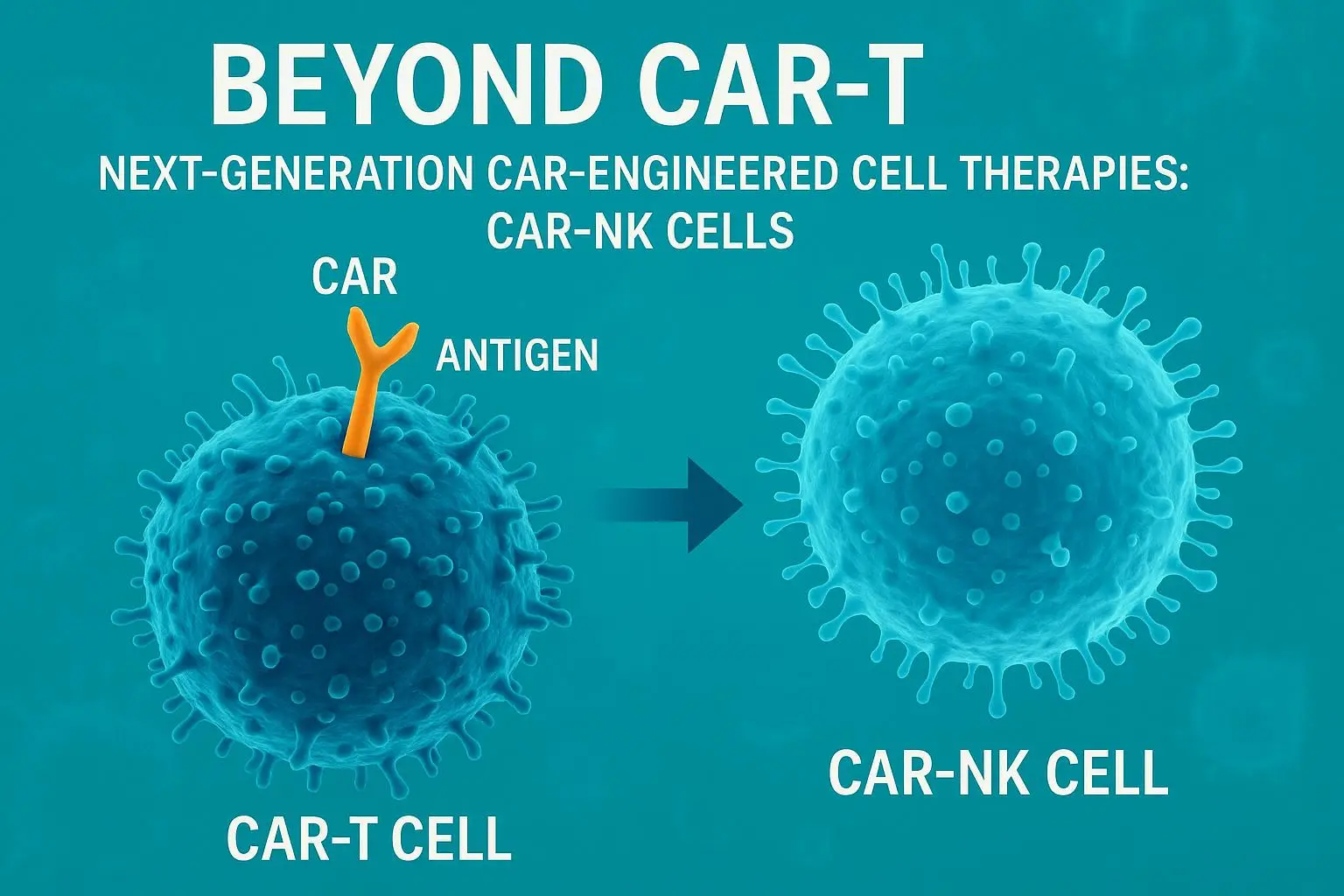
CAR-NK cells represent the next evolution in cancer cell therapy. Discover their advantages over CAR-T cells, their proven efficacy in hematologic and solid tumors, and the clinical breakthroughs shaping the future of immunotherapy.
Beyond CAR-T. Next-generation CAR-engineered cell therapies: CAR-NK Cells

Alexander Padron

José García
1. CAR-NK Cells Against Hematologic Malignancies – Preclinical and Clinical Studies
Initial studies on CAR-NK cells have focused on hematological malignancies. Anti-CD19 CAR-NKs from various cell sources and signaling domains demonstrated effective cytotoxicity against B-cell malignancies both in vitro and in vivo. Anti-CD19 CAR-NK-92 cells showed strong anti-lymphoma activity against Rituximab and Obinutuzumab-resistant B-cell lymphoma cells, utilizing granule-mediated apoptosis and IFN-γ signaling. They also secreted CCL3, recruiting NK cells, T cells, macrophages, and DCs to the TME. Augmenting anti-CD19 CAR-NK cells with the human CXCR4 gene improved their homing to the bone marrow. CRISPR-Cas9 knockout of NK cell immune checkpoints further enhanced their cytotoxicity. Bispecific CAR-NK cells targeting CD19/CD22 and BCMA/CD19 showed superior efficacy against B-cell lymphoma and multiple myeloma (MM) compared to single-antigen CAR-NKs.
Clinical Studies
In a phase I/II trial, anti-CD19 CAR-NK cells showed an objective response in 8 of 11 patients with CD19-positive leukemia or lymphoma. These cells expanded and persisted in patients for at least 12 months, and importantly, did not cause cytokine release syndrome (CRS), neurotoxicity, or graft-versus-host disease (GvHD).
AML and T-Cell Malignancies
CAR-NK cells targeting CD33, CD123, FLT3, and CD38 effectively killed AML cells in vitro and in vivo. CD38-CAR NK cells posed a fratricide risk due to CD38 expression on NK cells, which was mitigated by CD38 knockout. However, a phase I trial of anti-CD33 CAR-NK cells for relapsed/refractory AML showed no notable clinical efficacy. CAR-NK cells targeting T-lymphoid malignancies, such as anti-CD5, anti-CD7, and anti-CD4 CAR-NKs, have shown specific cytotoxicity in preclinical studies without the risk of fratricide.
2. CAR-NK Cells Against Solid Tumors
Preclinical Studies
CAR-NK cells targeting various solid tumor antigens, such as EGFR, HER2, Mesothelin, EpCAM, EGFRvIII, and PSCA, demonstrated potent cytotoxicity in preclinical studies. Comparative studies indicated that HER2-targeting CAR-NK cells exhibited superior cell-mediated tumor killing in vivo compared to CAR-T cells, and Mesothelin-targeting CAR-NK and CAR-T cells showed equivalent tumor reduction capabilities. CAR-NK cells have also shown potential as alternatives for therapy-resistant tumors, like triple-negative breast cancer and 5-FU-resistant colorectal cancer.
Clinical Studies
| CAR target | NK cell source | Cancer type | Phase | NCT number |
| CD19 | UCB | Hematological malignancies | I/II | NCT03056339 |
| CD19 | UCB | B-cell NHL | I | NCT05472558 |
| CD19 | UCB | Hematological Malignancies | I | NCT04796675 |
| CD19 | iPSC | B-cell Malignancies | I | NCT05379647 |
| CD19 | iPSC | Hematological Malignancies | I | NCT05336409 |
| CD19 | HPCs | B-cell lymphoma | I/II | NCT05654038 |
| CD19 | Not disclosed | B-cell NHL | I | NCT04887012 |
| CD19 | Not disclosed | Hematological Malignancies | I | NCT05645601 |
| CD19 | Not disclosed | Hematological Malignancies | I | NCT05410041 |
| CD19 | Not disclosed | Hematological Malignancies | I | NCT05020678 |
| CD19 | Not disclosed | ALL | I | NCT05563545 |
| CD19/CD70 | UCB | B-cell NHL | I/II | NCT05842707 |
| CD19/CD70 | UCB | B-cell NHL | I | NCT05667155 |
| CD33 | iPSC | AML | I | NCT05665075 |
| CD33 | iPSC | AML | I | NCT05601466 |
| CD33 | Not disclosed | AML | I | NCT05008575 |
| CD70 | UCB | Hematological Malignancies | I/II | NCT05092451 |
| CD70 | UCB | Solid Tumors | I/II | NCT05703854 |
| NKG2D | NK92 | Solid Tumors | I | NCT05528341 |
| NKG2D | Not disclosed | Colorectal cancer | I | NCT05213195 |
| PD-L1 | NK92 | GEJ cancers or HNSCC | II | NCT04847466 |
| DLL3 | NK92 | Extensive-stage SCLC | I | NCT05507593 |
| BCMA | iPSC | Multiple myeloma | I | NCT05182073 |
| HER2 | NK92 | Glioblastoma | I | NCT03383978 |
| Claudin6 | PBMCs | Reproductive system tumors | I/II | NCT05410717 |
| NKG2D ligands | Not disclosed | Hematological Malignancies | I | NCT04623944 |
3. CAR-NK vs. CAR-T therapies(safety, efficacy, cost)
| Aspect | CAR-T Therapy | CAR-NK Therapy |
| Safety | 1. High risk of CRS/ICANS: Severe cytokine release syndrome (CRS) and neurotoxicity in 20-50% of patients. 2. GVHD risk: Allogeneic use requires immunosuppression. 3. Tumor lysis syndrome: Reported in high-tumor-burden cases. |
1. Lower toxicity: Minimal CRS/ICANS (<13%) grade 1-2; severe cases rare) 2. No GVHD: MHC-independent killing avoids graft rejection. 3. NO IL-6 release: Reduces CRS drivers |
| Efficacy | 1. High response in hematologic cancers: 70-90% CR in B-ALL/DLBCL 2. Long-term persistence: CAR-T cells survive years, enabling durable remission. 3. Limited solid tumor success: Poor infiltration and TME suppression. |
1. Strong in indolent lymphomas: 83-100% CR in CD19+ lymphomas. 2. Activity against resistant tumors: Effective in 38% of CAR-T resistant lymphomas. 3. Solid tumor potential: Dual targeting (e.g., NKG2D + CAR) enhances efficacy. |
| Cost & Logistics | 1. Autologous production: 3-6 weeks manufacturing, costing $400,000-500,000 per dose. 2. Complex infrastructure: Requires specialized facilities. 3. Patient-specific: Limits scalability |
1. Off-the-shelf availability: Pre-made doses reduce cost ($100,000-150,000). 2. Rapid production: 2-3 weeks using iPSCs or NK cell lines. 3. Scalability: One donor serves multiple patients. |
Advantages: CAR-NK cells offer several advantages over CAR-T cells. They can be derived from various sources, are HLA-independent, and can be used allogeneically without the risk of GvHD. NK cells' innate ability to recognize tumor cells via native receptors makes them resistant to antigen escape. Clinical trials have shown CAR-NK cells have a lower risk of adverse effects like neurotoxicity and CRS compared to CAR-T cells. Their ability to distinguish between healthy and malignant cells reduces off-target toxicity. Additionally, safety mechanisms like the caspase-9-based suicide gene allow controlled elimination of NK cells if necessary.
Challenges and Solutions: CAR-NK cells face challenges such as limited persistence without cytokine support. Solutions include expressing membrane-bound IL-15, using IL-15 receptor fusion constructs, or genetically engineering NK cells to produce IL-15. Overcoming the immunosuppressive TME involves using decoy-resistant IL-18, dominant-negative TGF-β receptors, or knocking out TGF-β-induced miR-27-5p. Enhancing CAR-NK cell trafficking to tumors involves arming them with chemokine receptors like CCR7 and CXCR2
CAR-NK cells recognize cancer cells via their CAR and activating NK cell receptors. They induce anti-tumor toxicity through granzyme B/perforin secretion and death receptor-mediated killing (FasL, TRAIL), participate in ADCC and activate T cells through cytokine secretion
References
1. Marr B, Jo D, Jang M, Lee SH. Cytokines in focus: IL-2 and IL-15 in NK adoptive cell cancer immunotherapy. Immune Netw. 2025;25(2):e17.
2. Qiu Z, Li Z, Zhang C, Zhao Q, Liu Z, Cheng Q, Zhang J, Lin A, Luo P: NK Cell senescence in cancer: from molecular mechanisms to therapeutic opportunities. aging dis 2025.
3. Taveirne S, Wahlen S, Van Loocke W, Kiekens L, Persyn E, Van Ammel E, et al. The transcription factor ETS1 is an important regulator of human NK cell development and terminal differentiation. Blood. 2020;136(3):288–98.
4. Guia S, Fenis A, Baudesson De Chanville C, Galluso J, Medjouel H, Escaliere B, et al. Genome-wide CRISPR/Cas9 screen reveals factors that influence the susceptibility of tumor cells to NK cell-mediated killing. J Immunother Cancer. 2025;13(3):e010699.
5. Wang M, Krueger JB, Gilkey AK, Stelljes EM, Kluesner MG, Pomeroy EJ, et al. Precision enhancement of CAR-NK cells through non-viral engineering and highly multiplexed base editing. J Immunother Cancer. 2025;13(5):e009560.
6. Zhu W, Fan C, Zhao Y, Li W, Niu J, Dong S, Yang Z, Zhou W. The role of NK cells in regulating tumorimmunity: current state, challenges and future strategies. Cancer Cell Int. 2025 Oct 17;25(1):360. doi: 10.1186/s12935-025-03980-y. PMID: 41107895; PMCID: PMC12535086.