

CAR-γδT cells offer powerful antitumor activity, high safety, enhanced tumor infiltration, and strong potential as next-generation allogeneic immunotherapies.
Autor: Alexander Ariel Padron Gonzalez, José García
Innova Unlimited
https://innovaunlimited.com/es/manuales-y-compendios
CAR-γδT: a promising candidate for allogeneic cell therapy
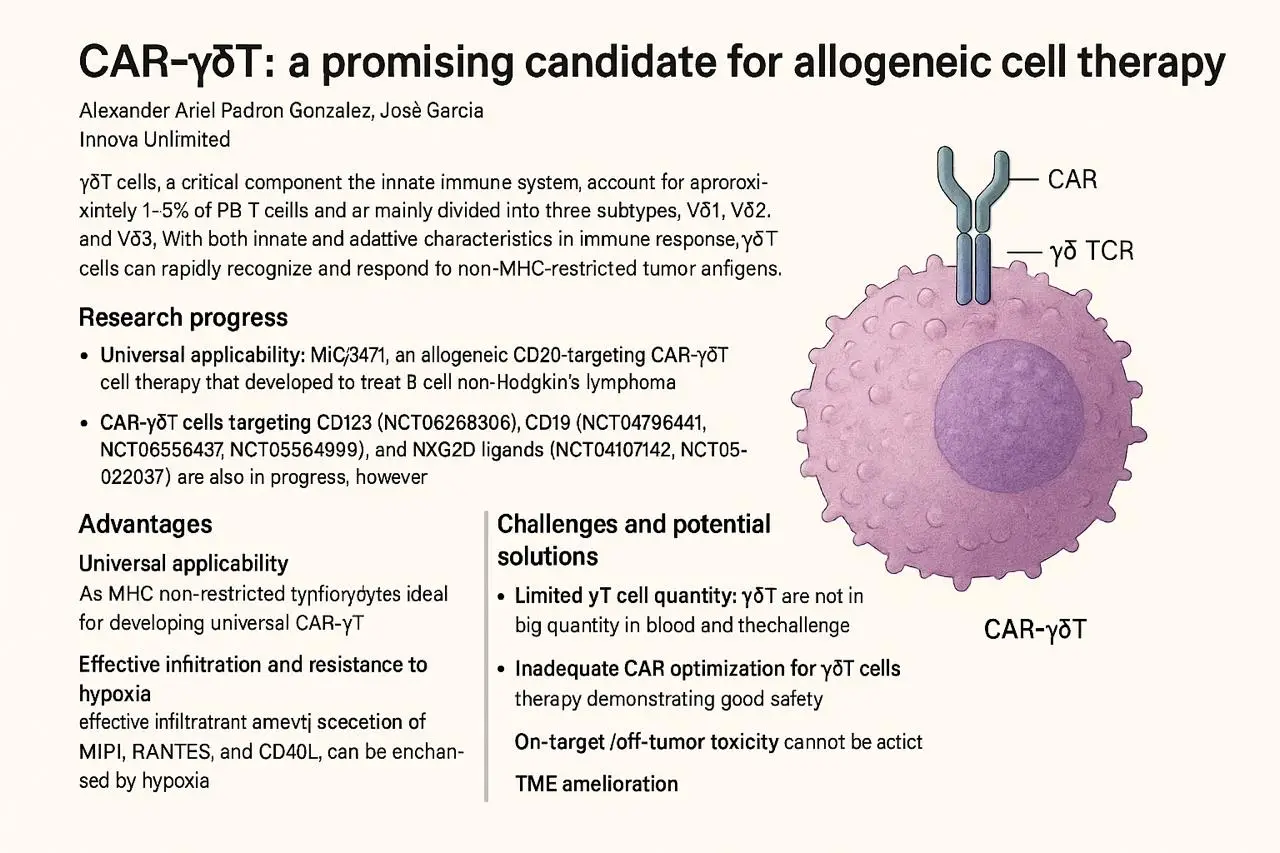
γδT cells share various unique features that could confer new capabilities to CAR-T cells. γδT cells, a critical component of the innate immune system, account for approximately 1–5% of PB T cells and are mainly divided into three subtypes: Vδ1, Vδ2, and Vδ3. With both innate and adaptive characteristics in immune response, γδT cells can rapidly recognize and respond to non-MHC-restricted tumor antigens.
Research progress
Clinical trials: ADI-001: NCT04735471, an allogeneic CD20-targeting CAR-γδT cell therapy that was developed to treat B cell non-Hodgkin’s lymphoma
CAR-γδT cells targeting CD123 (NCT05388305), CD19 (NCT04796441, NCT02656147, NCT05554939), CD7 (NCT04702841), and NKG2D ligands (NCT04107142, NCT05302037) are also in progress; however, clinical data have not yet been published.
Advantages
Multiple killing modes
In addition to CAR-mediated cytotoxicity, γδT cells can also recognize tumor cells through intrinsic receptors and activate various natural tumor-killing pathways, such as perforin/granzyme-dependent cytotoxicity, CD16-mediated ADCC, and TRAIL/FASL-triggered apoptosis. Additionally, γδT cells can also serve as APCs that present tumor antigens to αβT cells.
Universal applicability: As MHC non-restricted lymphocytes, γδT cells differ from αβT cells in that they do not cause GvHD, making them ideal for the development of universal CAR-γδT therapy
Effective infiltration and resistance to hypoxia
γδT cells, particularly the Vδ1 subtype, have a homing advantage over αβT cells and are thus better able to infiltrate tumors, especially those with a hypoxic TME. Additionally, γδT cells may function more effectively in the hypoxic TME because their cytotoxicity, as well as their secretion of MIP1, RANTES, and CD40L, can be enhanced by hypoxia.
TME amelioration
Activated γδT cells can secrete various pro-inflammatory cytokines and chemokines to create an inflammatory environment. Additionally, γδT cells serve as a bridge between innate immunity and adaptive immunity, promoting the maturation of DCs, activating NK cells, promoting antibody production in B cells, and improving the humoral immune response. Moreover, γδT cells can serve as APCs and mobilize bystander immune cells to attack tumor cells.
Challenges and potential solutions
Limited γδT cell quantity: γδT are not in big quantity in blood and the challenge of in vitro expansion.
Inadequate CAR optimization for γδT cells: γδT cell therapy has demonstrated good safety in recent studies, the likelihood of CAR-related on-target/off-tumor toxicity cannot be neglected.
The improvement and maintenance of in vivo persistence in γδT cells also represent obstacles that may be overcome by employing molecular factors that support cell survival and functionality.
Despite significant progress in preclinical and early clinical studies with CAR-γδT cells in hematological malignancies, their clinical efficacy in solid tumors remains uncertain and may be affected by the complexity and heterogeneity of the immunosuppressive TME. To address the existing and forthcoming challenges in clinical applications, a thorough understanding of CAR-γδT cells is required. However, the potential of CAR-γδT cell therapy cannot be overlooked. The future development of CAR-γδT cell therapy still deserves considerable attention.
CAR-T vs CAR-γδT
| Category | CAR-T |
CAR-γδT |
| Effector cell |
CTL/ Th | γδT |
| Marker |
CD3⁺CD8⁺/ CD3⁺CD4⁺ | CD3⁺γδTCR⁺ |
| Cell source |
PBMC, iPSC, UCB | PBMC, iPSC |
| Tumor recognition pattern |
CAR-dependent | CAR-dependent and independent |
| Tumor killing pattern |
Perforin/granzyme, cytokine | Perforin/granzyme, cytokine, ADCC, Fas/FasL, TRAIL/TRAILR |
| Safety | Moderate: may cause CRS, ICANS; may cause GvHD (Allogeneic T cells) and off-tumor toxicities | High: reduced risk of GvHD, CRS, ICANS; may cause off-tumor toxicities |
| Infiltrating ability | Low | High |
| In vivo persistence |
Moderate | Low |
| Improve tumor microenvironment (TME) |
Low | High |
| Gene transfer |
Easy (RV, LV, etc.) | Difficult |
| Potential for off-the-shelf products |
Low | High |
| Research progress |
Products have been marketed | Phase 1/2 |
| Manufacture cost |
Moderate | High: limited cell source |
| Manufacture time |
Moderate | Moderate |
| Antigen pool | Limited — only extracellular antigens | Limited — only extracellular antigens |
References
1-https://doi.org/10.1186/s13045-023-01492-8
2-https://www.mdpi.com/2072-6694/17/7/1063
3-https://doi.org/10.3389/fimmu.2025.1675807
4-https://doi.org/10.1038/s41392-023-01653-8
5-https://doi.org/10.1002/hem3.70182
6-https://doi.org/10.1186/s12935-024-03479-y
7-https://doi.org/10.1016/j.medj.2025.100677
BLOG COMMENTS POWERED BY DISQUS