


Blood-based multi-cancer early detection (MCED) tests: biological basis, clinical evidence, predictive value, risks, regulatory views, and future perspectives.
Blood Tests for Early Cancer Detection: Do They Work?
Biological Foundations, Clinical Evidence, Regulatory Perspectives, and Outlook (MCED)
 |
| Dr. Adrián Pablo Huñis |
|
School of Medicine – University of Buenos Aires Honorary Member, AMA |
A) Abstract
Blood-based multi-cancer early detection (MCED) tests have gained both public visibility and increasing clinical availability. These platforms aim to identify tumor-derived signals in the bloodstream—mainly circulating tumor DNA (ctDNA) and DNA methylation patterns—and, in some cases, infer the tissue of origin. Although these tests exhibit high analytical specificity and can detect cancers lacking established screening programs, their sensitivity for early-stage disease remains limited. To date, no randomized clinical trial has demonstrated a reduction in cancer-specific mortality attributable to MCED use.
Moreover, because of the low prevalence of cancer in asymptomatic populations, even with specificities near 99%, the positive predictive value (PPV) may remain modest, leading to potential diagnostic cascades, patient anxiety, incidental findings, and overdiagnosis. This review discusses definitions, test types, differences from liquid biopsy, the current state of evidence, the stance of regulatory agencies and professional societies, and realistic future scenarios.
B) Introduction
Cancer screening is a public health intervention, not merely a laboratory test. To justify implementation, it must demonstrate a net clinical benefit—that is, reduced cause-specific mortality, acceptable risk-benefit balance, cost-effectiveness, and minimization of harms such as overdiagnosis, false positives, and unnecessary procedures.
Experience with PSA screening and breast cancer overdiagnosis illustrates that detecting more disease does not necessarily translate into saving more lives, and that epidemiologic parameters—particularly disease prevalence and PPV/NPV—are decisive.
MCED technologies have emerged from the convergence of next-generation sequencing (NGS), epigenomics, and machine learning. Their promise is twofold:
1. To detect cancers for which no standard screening exists, and
2. To identify disease at a potentially curable stage.
However, the central question is not whether these tests can detect molecular signals, but rather whether their systematic use can reduce cancer mortality without generating disproportionate harm or cost.
C) Definition of MCED Tests
MCED tests are blood-based assays designed to identify a “cancer signal” from plasma or serum biomarkers in asymptomatic individuals, typically aged ≥50 years or at increased risk. The most commonly used biomarkers include:
1. cfDNA/ctDNA methylation patterns
2. Somatic mutations in cfDNA
3. Circulating proteins and other molecular markers, often combined in multimodal models
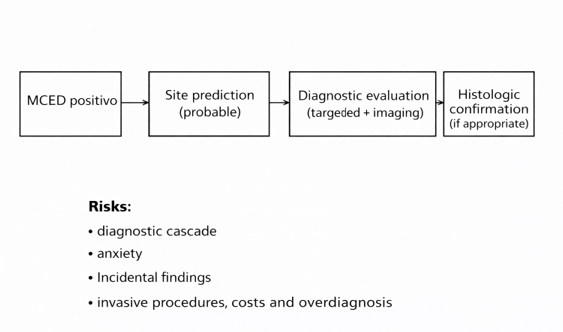
Operationally, a positive MCED result is not diagnostic and requires confirmatory evaluation through imaging and/or tissue biopsy. Conversely, a negative result does not exclude the presence of cancer and should not replace established screening programs.
D) Types of Tests (Biological, Molecular, Genetic)
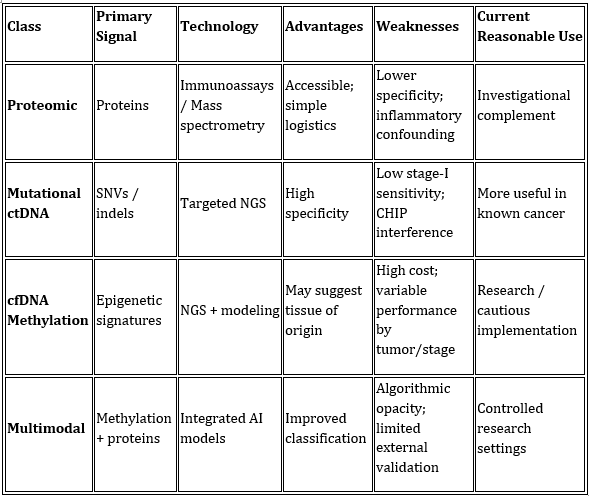
1. Proteomic / classical biomarker assays:
Use cancer-associated or inflammation-related proteins. Accessible and simple to implement, but less specific.
2. Mutational ctDNA assays:
Detect somatic variants in cfDNA using targeted NGS. Highly specific but often insensitive in minimal disease.
3. DNA methylation (epigenomic) assays:
Exploit tissue- and tumor-specific methylation signatures. Among the most advanced MCED strategies to date.
4. Multimodal approaches:
Combine multiple data layers (e.g., methylation + proteins + clinical variables) using AI models to improve diagnostic performance.
Table 1. Practical Classification of MCED Tests and Clinical Attributes
E) MCED vs Liquid Biopsy and ctDNA (Definitions, Strengths, and Weaknesses)
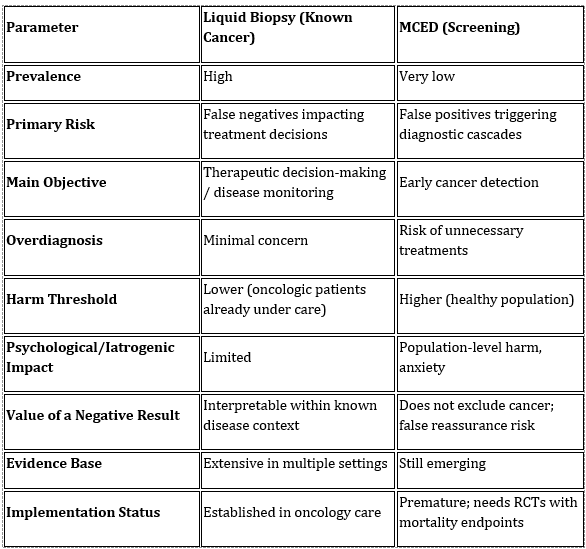
Liquid biopsy is a broad term referring to the analysis of circulating tumor material—such as ctDNA, circulating tumor cells (CTCs), or exosomes—in patients with an established cancer diagnosis. Its goals include genotyping, monitoring therapeutic response, and detecting resistance mechanisms.
ctDNA is the fraction of cell-free DNA (cfDNA) derived specifically from tumor cells. In advanced disease, ctDNA is typically measurable; however, in early-stage disease, it may be extremely scarce.
MCED, by contrast, applies these same technologies to screening asymptomatic populations. This shift fundamentally alters the context:
low disease prevalence markedly reduces PPV, and the clinical cost of false positives and negatives becomes disproportionately high.
Table 2. Key Differences Between MCED and Liquid Biopsy in Known Cancer
Current Evidence, Performance, and Clinical Challenges
Major validation studies for cfDNA methylation-based MCED tests have demonstrated specificities exceeding 99% and moderate overall sensitivity, with significantly lower sensitivity in early-stage disease and heterogeneity across tumor types.
In the methylation-based approach reported by Liu et al. (2020), overall sensitivity was approximately 55% at >99% specificity, while the accuracy of tissue-of-origin localization exceeded 90% among detected cases.
In prospective cohort studies (e.g., PATHFINDER), these tests have guided diagnostic workups and confirmed cancer in a subset of positive cases. However, no study has yet demonstrated a mortality reduction, and available evidence remains vulnerable to verification bias, lead-time bias, and length-time bias. Additionally, studies have documented psychosocial impacts and a significant diagnostic burden following positive results.
F) Major Clinical Issues
1) Limited Positive Predictive Value (PPV) in the general population — determined largely by cancer prevalence, not only specificity.
2) False negatives, particularly in stage I disease — these tests cannot replace established screening protocols.
3) Diagnostic cascades — follow-up imaging, endoscopies, biopsies, and incidental findings may occur.
4) Overdiagnosis — detection of indolent cancers or lesions of uncertain significance.
5) Biological confounders — clonal hematopoiesis of indeterminate potential (CHIP) may mimic tumor-derived signals.
6) Equity and cost considerations — access, insurance coverage, and cost-effectiveness remain unresolved.
Figure 1. Cancer prevalence versus positive predictive value (PPV) (epidemiological model with sensitivity = 55% and specificity = 99%).
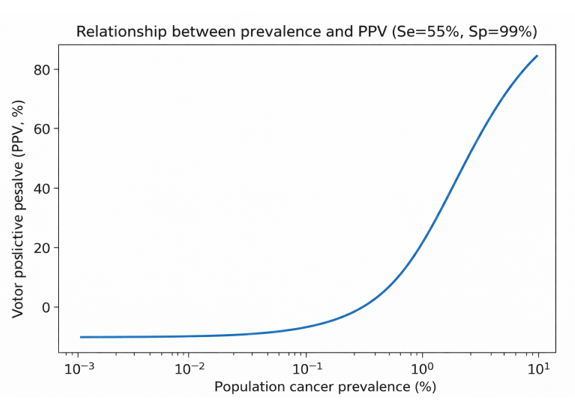
Figure 2. Sensitivity by cancer stage (illustrative; showing the expected pattern of lower sensitivity in stage I).
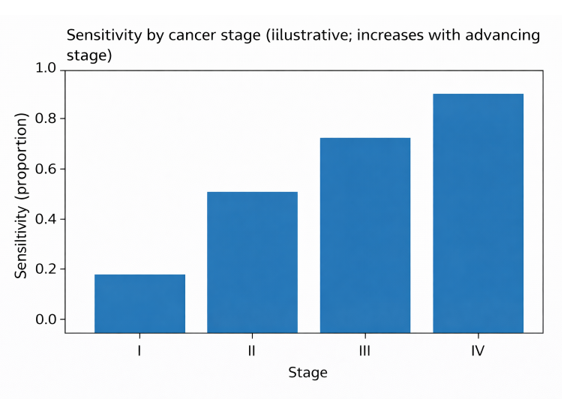
Figure 3. Biological schematic illustrating the origin of cfDNA/ctDNA and the limitation in minimal disease (early-stage cancer).
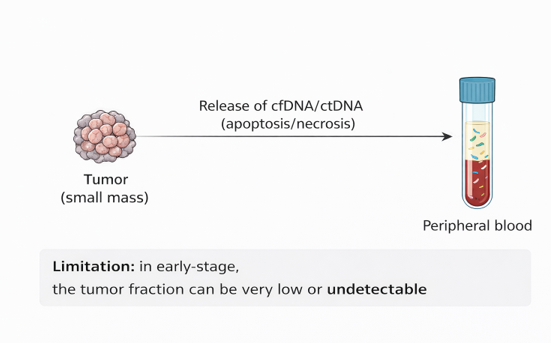
Figure 4. Clinical workflow following a positive MCED result and associated key risks.
Figures (described)
Figure 1. Epidemiological model: Cancer prevalence vs PPV (Se = 55%, Sp = 99%).
Figure 2. Sensitivity by stage: Illustrates typical decline in detection for stage I disease.
Figure 3. Biological schematic: Origin of cfDNA/ctDNA and limitations in minimal disease.
Figure 4. Clinical workflow following a positive MCED result and associated risk pathways.
G) Regulatory Agencies and Institutional Positions
In the United States, several MCED tests are currently available as laboratory-developed tests (LDTs) under the Clinical Laboratory Improvement Amendments (CLIA) framework for high-complexity testing.
However, none have received FDA approval or clearance for use as population-level cancer screening tools.
Official product websites explicitly acknowledge the absence of FDA approval and warn of potential false results.
Regarding recommendations, the U.S. Preventive Services Task Force (USPSTF) continues to issue Grade A/B recommendations for well-established screenings—such as breast, cervical, colorectal, and lung cancer in high-risk populations—but has not endorsed MCED tests for general screening.
Professional and academic societies, including the American Society of Clinical Oncology (ASCO), describe MCED technology as being at a “tipping point”: scientifically promising but not yet clinically validated.
They emphasize the need for prospective studies demonstrating clinical utility, with hard endpoints such as mortality reduction, quality of life, and net harm assessment, before considering widespread adoption.
Similarly, the American Cancer Society (ACS) concurs that MCED tests should not replace existing evidence-based screenings and that their role in clinical practice remains to be defined.
H) Future Outlook — What May Be Reasonable and What Is Not
The plausible future of MCED testing depends on demonstrating clinical utility and net benefit. Several realistic scenarios include:
- High-risk populations:
Use in groups with elevated baseline risk (e.g., hereditary cancer syndromes, heavy tobacco exposure, or prior oncologic history), where higher prevalence improves PPV.
- Complementary role:
Adding detection of cancers that lack validated screening programs, without displacing existing modalities such as mammography, colonoscopy, HPV testing, or low-dose CT.
- Standardized diagnostic pathways:
Developing structured workup algorithms following a positive MCED to minimize iatrogenic harm.
- Cost-effectiveness modeling:
Rigorous evaluation of cost per life-year gained and equitable resource allocation.
I) Currently Unreasonable Scenarios
- Presenting MCED as a replacement for validated screening tests.
- Claiming mortality reduction without randomized controlled trial (RCT) evidence or equivalent data.
- Implementing MCED programs without diagnostic protocols, or without transparent communication of limitations and risks to patients.
J) Conclusions
MCED technologies represent a remarkable scientific and technological advance, particularly in cfDNA methylation profiling and tissue-of-origin prediction.
However, current evidence supports, at best, analytical and clinimetric feasibility—not yet a proven population benefit in terms of mortality reduction.
In cancer screening, epidemiology governs outcomes: low disease prevalence results in modest PPVs, while false positives, diagnostic cascades, and overdiagnosis remain central risks.
At present, the most prudent use of MCED is within research settings or highly controlled implementation frameworks, as a complement rather than a substitute for validated screening methods.
J) References
1. Wilson JMG, Jungner G. Principles and Practice of Screening for Disease. Geneva: WHO; 1968.
2. Mandel JS, et al. Reducing mortality from colorectal cancer by screening for fecal occult blood. N Engl J Med. 1993;328(19):1365–1371.
3. Tabár L, et al. Swedish two-county trial: impact of mammographic screening on breast cancer mortality. Lancet. 2011;378(9805):140–146.
4. Welch HG, Black WC. Overdiagnosis in cancer. J Natl Cancer Inst. 2010;102(9):605–613.
5. Welch HG, et al. Breast-cancer tumor size, overdiagnosis, and mammography screening effectiveness. N Engl J Med. 2016;375(15):1438–1447.
6. Prasad V, et al. Overdiagnosis and overtreatment in cancer. BMJ. 2020;368:m620.
7. Etzioni R, et al. The case for early detection. Nat Rev Clin Oncol. 2022;19(1):29–40.
8. Alix-Panabières C, Pantel K. Clinical applications of circulating tumor cells and ctDNA. Nat Rev Cancer. 2016;16(7):409–424.
9. Bettegowda C, et al. Detection of circulating tumor DNA in early- and late-stage cancers. Sci Transl Med. 2014;6(224):224ra24.
10. Liu MC, et al. Sensitive and specific multi-cancer detection and localization using methylation signatures in cfDNA. Ann Oncol. 2020;31(6):745–759.
11. Klein EA, et al. Clinical validation of a targeted methylation-based multi-cancer early detection test using an independent validation set. Ann Oncol. 2021;32(9):1167–1177.
12. Schrag D, et al. PATHFINDER: prospective cohort study of blood-based multi-cancer early detection. Cancer. 2023;129(18):3124–3135.
13. Nabavizadeh N, et al. Safety and performance of a multi-cancer early detection test (Galleri). Ann Oncol. 2025;36(Suppl):LBA64.
14. Nadauld L, et al. Psychosocial impact associated with multicancer early detection testing (PATHFINDER). Lancet Oncol. 2025;26.
15. Guerra CE, et al. Multicancer early detection tests at a crossroads. ASCO Educational Book. 2025:e473834.
16. American Cancer Society. Multi-cancer Early Detection (MCED) Tests. 2025.
17. U.S. Preventive Services Task Force. A and B Recommendations (Screening Topics). 2025.
18. GRAIL. Galleri Test website: Not FDA cleared or approved; limitations and false results. 2025.
19. Vittone J, et al. A multi-cancer early detection blood test using machine learning: overview and implementation considerations. NPJ Genom Med. 2024;9:47.
20. Chiu RWK, Lo YMD. Cell-free DNA in plasma: biology and clinical applications. Clin Chem. 2020;66(1):1–10.
21. Taavitsainen S, et al. Clonal hematopoiesis confounding in cfDNA analyses. Nat Rev Genet. 2023;24(8):477–489.
22. Phallen J, et al. Direct detection of early-stage cancers using circulating tumor DNA. Sci Transl Med. 2017;9(403):eaan2415.
23. Newman AM, et al. An ultrasensitive method for quantitating circulating tumor DNA with broad patient coverage. Nat Med. 2014;20(5):548–554.
24. Croswell JM, et al. Cumulative incidence of false-positive results in cancer screening. Ann Fam Med. 2009;7(3):212–222.
25. Esserman LJ, et al. Addressing overdiagnosis and overtreatment in cancer: a prescription for change. JAMA. 2014;312(8):799–800.
26. Woolf SH, et al. Screening benefits and harms: communicating uncertainty. Ann Intern Med. 2010;152(1):1–8.
27. U.S. Food and Drug Administration (FDA). In vitro diagnostics and cancer screening oversight. 2024–2025.
28. Centers for Medicare & Medicaid Services (CMS). CLIA Laboratory Testing Overview. 2024.
29. National Academies of Sciences. Biomarker Tests and Evidence Standards. 2017.
30. Shieh Y, et al. Population-based screening: risk-based strategies. JAMA. 2020;323(1):15–16.
31. Oxnard GR, et al. Liquid biopsy in oncology: indications and limits. J Clin Oncol. 2020;38(15):1622–1631.
32. Reinert T, et al. Circulating tumor DNA for detection and monitoring of minimal residual disease. Nat Rev Clin Oncol. 2021;18(10):601–613.
33. IARC Handbooks. Cancer Screening and Early Detection: Principles. 2019.
34. SEER Program (NCI). Cancer Prevalence and Incidence Basics. 2024.
35. Lopez DS, et al. Cost-effectiveness considerations in multicancer screening. Pharmacoeconomics. 2023;41(6):513–526.
36. Hubbard RA, et al. Decision analysis in screening. Stat Med. 2017;36(19):3047–3064.
37. Ransohoff DF. Bias as a threat to the validity of cancer screening studies. N Engl J Med. 2005;352(21):2181–2183.
38. Black WC, Welch HG. Advances in screening and lead-time bias. J Gen Intern Med. 1997;12(10):661–667.
39. Patel MI, et al. Equity in cancer screening: the role of policy, providers, and access. CA Cancer J Clin. 2020;70(6):423–439.
40. National Comprehensive Cancer Network (NCCN). Cancer Screening Guidelines Overview. 2025.
41. European Medicines Agency (EMA). In Vitro Diagnostic (IVD) Regulation Framework Overview. 2024.
 |
https://www.linkedin.com/in/aphunis/ |